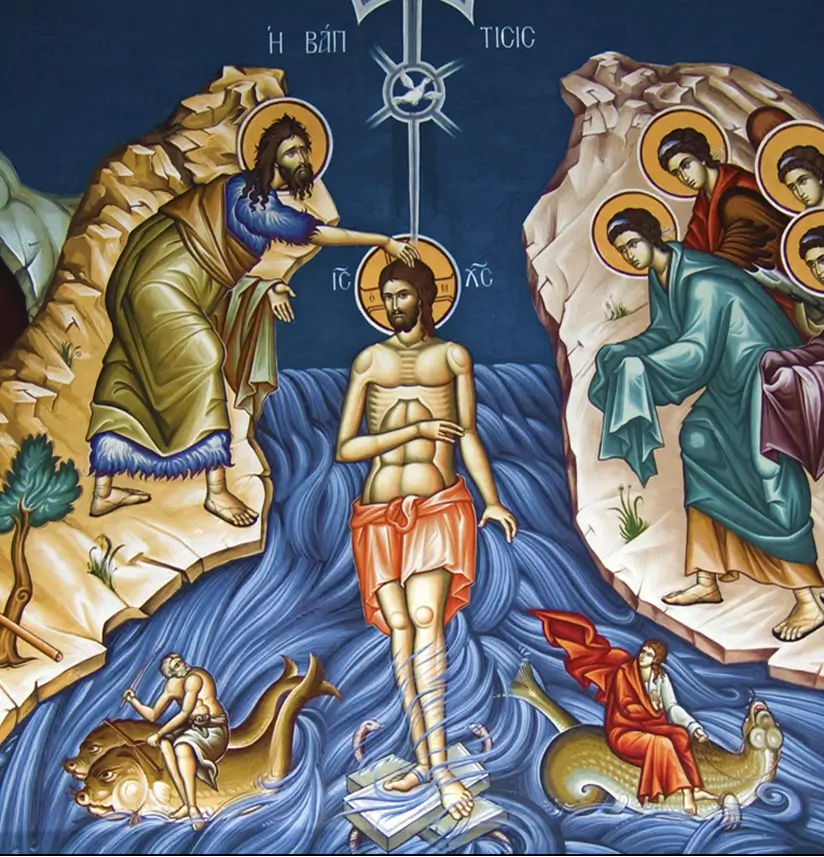
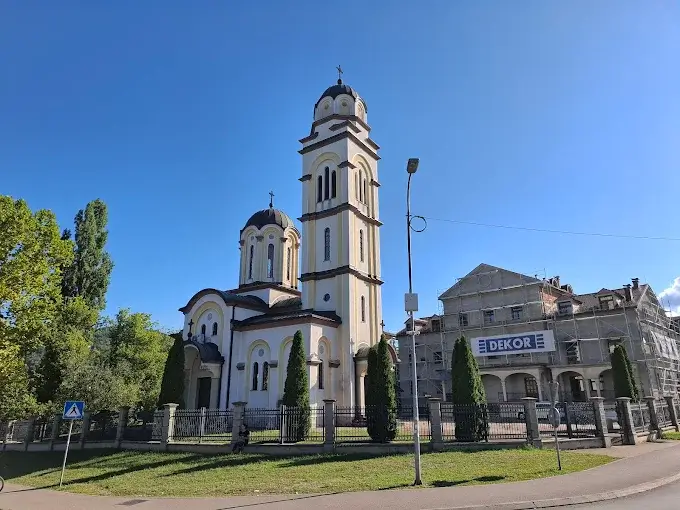
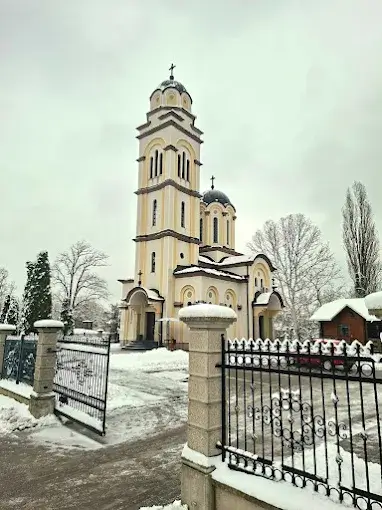
The Temple of the Epiphany of the Lord is a parish temple of the Serbian Orthodox Church, Diocese of Banja Luka in Banja Luka. He was consecrated on September 18, 2011. The act of great consecration was performed by His Highness Mr. G. Efrem, Metropolitan of Banja Luka, and His Highness Mr. G. Basil, Metropolitan of Srem, with the service of several priests and deacons of the Diocese of Banja Luka.
On the same occasion, at the suggestion of the elder of the temple priest Zoran Pajkanovic, the godparents of the Epiphany Temple were proclaimed: Mr. Vinko and Milena Vujasin from Banja Luka.
The Temple of the Epiphany of the Lord enters the narrower center of the city. It is located directly next to the fortress “Kastel”. The Vrbas River flows from the east side of the temple. The two sides of the Vrbas River are connected by the so-called. The city bridge, which until 1930 was wooden, then replaced by concrete. Since 2015, this bridge officially bears the name “Patra”, in gratitude to the fraternal Greek people of the Greek city of Patra for almost the only assistance provided during the last civil war.
Worship life
In the Epiphany temple there is a very dynamic worship life. In addition to regular daily services, sacred liturgies are served daily on Saturdays, Sundays, and also during multi-day fasts (except Easter).
Three akathists are also served in the temple as an extension of the evening service:
- On Mondays, the akathist of St. Nectaria of Aegina (in the temple there is also a particle of the relics of St. Nectaria, inserted into his icon on the right throne),
- on Thursdays, the akathist is served to the Holy Imperial Martyrs Romanov and
- On Sundays, the akathist of St. Savi, the first Serbian Archbishop.
The location of the Epiphany Temple was not chosen by chance. Namely, until the Second World War, there was a famous Epiphany lithe that went to the City Bridge, where there was a large water consecration and swimming for the Honorable Cross. With the arrival of the communist authorities, this custom was abolished and then restored after the Civil War. It was convenient that, on the occasion of the Epiphany holiday, the litja ended on the site near Vrbas. Hence the idea of building a church right next to the Vrbas River, as well as dedicating it to the Lord's Feast of Epiphany.
On the other hand, the tradition of the Church states that there used to be a Serbian Orthodox Church next to the Vrbas River. Like many others, the church was demolished during the time of Ottoman rule. Many believe that it cannot be reliably said where the church was located. However, certain circumstances and indisputable arguments give us the right to believe that the church existed on the site of today's Ferhadiya, i.e. Ferhat-pasha mosques.
Here are some references to this claim:
- It is known that in the immediate vicinity of each church there is a church plot, i.e. large porches of the temple, suitable and necessary for the life of the church itself. By some miracle, even today the land in cadastral records, practically next to Ferhadija itself, is kept as the property of the Serbian Orthodox Church. The word “miracle” is not an exaggeration, given the fact that the communist authorities in Banja Luka itself, as well as in today's suburbs, nationalized over 190 dunums of church land, of which there is a clear record. In 1952, the communist regime approved the construction of the “Veselin Maslesha” Student Home on the church land. It was demolished in 1970 after an earthquake, and on that site was built the Technical College and then the current Faculty of Electrical Engineering. As noted, the land on which the Faculty of Electrical Engineering is located is still led in the cadastre to the Church, which is directly next to Ferhadija.
- A very common practice of Islamic culture throughout history has been to build one's own on the foundations of other people's places of worship. Such an example is evident on the foundations of the Jerusalem temple. Likewise, churches were converted into mosques, and the Church of St. Sophia in Constantinople is an obvious example.
- When Ferhadija, unfortunately, was demolished in the civil war in 1993, Croatian archaeologist Boris Graljuk investigated the destroyed foundations in detail and published the following headline in Nezavisni novine on August 3, 2001: “On the site of Ferhadija there was a church”. Truth be told, his tendencies went in the direction of the existence of the Roman Catholic Church, which in no way fits into the historical context. Similar claims, without any basis, Croatian historians point to the account of several ancient Orthodox monasteries, such as the Gomionica monastery, which is a scientific absurdity. It should also be added that Graljuk also mentions several graphics in Banja Luka from the 17th century, where a church burning in the position of Ferhadija was painted. Most likely, it is the Serbian Orthodox Church, on the foundations of which Ferhadi was erected.
Architecture and layout
The temple was built in the traditional Orthodox style, with a simple and harmonious architectural solution with an inscribed cross. The building has a bell tower, a dome and an altar part oriented to the east.
Cultural and spiritual center
Next to the Epiphany Temple there is an imposing Cultural and Spiritual Center, the size of which is almost 1400 square meters. It contains the rooms necessary for a smooth parish life, but also, in addition to the parish hall, there is another lecture hall. A rich library is provided, as well as rooms for youth gatherings. The cultural and spiritual center should have an Enlightenment and missionary character, with a tendency to establish and renew Orthodox societies under the patronage of the Church.