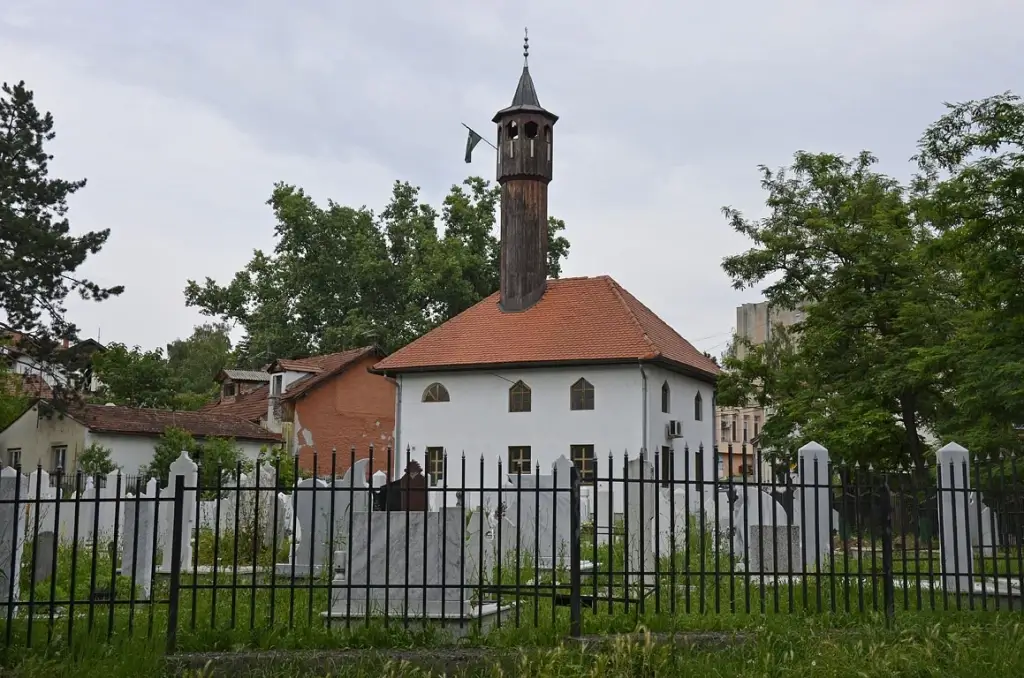
Hadži Omer's Mosque, also known as the Dolac Mosque, is located in the Banja Luka neighborhood of Dolac, in the foothills of the Kastel Fortress. It is one of the most significant historical and cultural monuments of Islamic heritage in Banja Luka. For over four centuries, it served as a gathering place for worshippers and an essential part of life in the former Dolac mahala.
Thanks to its long history, authentic architecture, and cultural significance, the Hadži Omer Mosque holds a special place among the landmarks of Banja Luka today.
History of the Hadži Omer Mosque
The exact year of construction has not been definitively established. According to most historical sources, the mosque was built around 1618, as the name of its founder appears in the 1618 waqf-nama (deed of endowment) of Sefer-spahija. Some authors suggest it was built slightly later, in 1686, but the early 17th century is considered the most likely period of its origin.
The mosque was built during a time of intense development in Banja Luka, when new neighborhoods and numerous waqf buildings were emerging, shaping the city's landscape.
Architecture of the Dolac Mosque
The Hadži Omer Mosque belonged to the traditional Bosnian mosque style, featuring a wooden minaret, a hipped roof, and an open porch. The porch rested on wooden pillars connected by wooden arches, while one section included an upper level accessed by an external staircase leading to the mahfil (gallery).
This construction style was characteristic of smaller urban mosques from the Ottoman period and represents a valuable example of traditional Bosnian sacred architecture.
The Harem and Cultural Value
Adjacent to the mosque is a spacious harem (cemetery) that began to form shortly after the mosque's construction. It contains a large number of old and newer tombstones, including particularly valuable examples of intricately carved stone markers that bear witness to the centuries-old history of the Dolac neighborhood.
Due to its historical, architectural, and cultural value, the site and remains of the Hadži Omer Mosque were declared a National Monument of Bosnia and Herzegovina in 2003.
Destruction and Reconstruction
During the war in Bosnia and Herzegovina, the Hadži Omer Mosque was set on fire and demolished in September 1993. Shortly thereafter, the remaining ruins were cleared, resulting in the loss of one of the oldest religious buildings in this part of Banja Luka.
Post-war reconstruction began, and the restored mosque was officially opened on July 14, 2007. The reconstruction restored the spiritual and cultural role of this historical site, although the rebuilt structure is not entirely identical to its original appearance.
Visiting the Hadži Omer Mosque
Today, the Hadži Omer or Dolac Mosque is an important part of Banja Luka's cultural and historical heritage. Its location near the Kastel Fortress and the city center makes it easily accessible to visitors who wish to learn about the city's rich history and its Islamic heritage.
A visit to this mosque offers the opportunity to explore one of the oldest preserved congregational sites in Banja Luka and to experience a piece of the city's history that, despite numerous destructions, has been preserved and passed on to future generations.


.webp)

.webp)
.webp)
.webp)
%20(1).webp)
.webp)
.webp)
.webp)
.webp)
%20(1).webp)